Tuesday, April 9, 2013

Khatami, The Ethical Politician

Presidential elections will be held along with nationwide council elections in mid June.  General economic and social conditions have prompted the Reformists who are still under pressure and restrictions after the disputed elections in 2009, to engage in a broad discourse on their political role in the future. Former President Khatami held consultative sessions for the past months and began a controversial debate on how reformists should face the upcoming electoral process. Diverse social and political orientations who feel close to the reformist camp took part and presented their assessments on the current status of affairs and on the options available for Reformists. A comprehensive study on the economic and social trends in Iranian society indicates that the targets and goals set in the 20- year Vision of the Islamic Republic and the development plans have not been achieved and that  lawlessness and incompetence have plagued government processes and programs during these recent  years. Following long hours of reporting and discussions, Reformists came to the  consensus that as believers in  reform they do not support regime change and nor can  they accept the expenses of another revolution, nor do they believe in violent methods, and even more they believe that any change must come as the result of an internal effort based on the diverse political orientations of the Iranian society. The terrible fate of Afghanistan, Iraq, Syria and Libya and other regional countries cannot be applied to Iran. Therefore, social and political reforms within the existing frameworks need to be promoted and the electoral process with all the current shortcomings and restrictions is one of the most important means of achieving those objectives.  Although consensus on council elections was readily attained, but in the next phase all groups and representations came to the conclusion that we need to take part in both council and presidential elections. Concerns on the fairness of the election process also were debated.  Planning for the council elections has since been underway.
The ensuing debates on the possible scenarios and candidates  for the office of the President was more complicated and difficult. Reformists were banned from convening their national convention on this matter. All political parties were consulted and considering the ongoing restrictions and pressures, their views were incorporated in the reports and synthesis.  Reports on polls conducted by government offices also indicated that Khatami had an overwhelming popularity albeit years of ongoing efforts to smear his image. The majority of the participants in the discourse believed that a well known candidate with a clear background of reformist activity who has remained loyal to the reformist camp,  despite  the pressures should be appointed.  The criteria for a candidate who can respond to the diverse expectations of the constituency and who can regenerate an atmosphere of hope and national esteem were discussed . Although Mr. Khatami had announced initially that he was not willing to stand for candidacy , but the majority of the political groups and the activists even those in prison or exile announced their support for his candidacy. Khatami is a popular public figure, he does not belong to a particular orientation; he represents the general Iranian mentality.

On the eve of the new year, I joined 91 activists in inviting Khatami to stand for these elections. We issued the first official communique on this matter and subsequently 45 members of the consultative group presented their assessment of current conditions and a plan for reform in government processes and policies.
The general public have gradually  welcomed the call and initial evaluations point to much hope in this regard although he has not yet announced his candidacy.
Many other groups have now announced their support and readiness to stand behind Khatami in the upcoming elections.
Khatami has set the standards for integrity, competency and good governance . He is the living standard for Reformists and Iranians who aspire for an advanced and prosperous nation. His legacy stands as  a politician who kept his ethical and human standards while in office. Never did his unrivalled popularity and  power as a president   cause him to abuse power or to undermine legal or ethical standards. Even though, Khatami later faced many baseless allegations by his rivals and many members of his government and reformists faced imprisonment but he never waivered on his principles and stood firm in his resolve to change the current unfavorable conditions in Iran.
 

Thursday, March 28, 2013

Neighboring Pakistan and US Drones


Pakistan is a neighboring Muslim country with a population of over 176 million. I have visited Karachi for two weeks in 1994 during a joint training course on immuno-chemistry as a course requirement for  PhD students of immunology. We were hosted by the Karachi University faculty led by the late Professor Zafar Zaidi and we enjoyed their kindness and hospitality. The attire and customs observed by the faculty and students indicated their high esteem for their national heritage and culture.
 Karachi is a over populated port, quite modern and advanced in some quarters but most of the city was marked by under development and poverty. Dr. Zaidi was quite concerned for our security due to the activities of violent Salafi groups like the Sepahe Sahabe and he asked us to use the University van allocated to our group for transportation. One day we devised an escape plan and went to the traditional bazaar to get a taste of the local culture and atmosphere. On the way back we took a minibus which was very noisy and overcrowded  and gave us a close up to life in Karachi.
We enjoyed the stay and the university held a graduation ceremony for us at the end of the course. The presence of an American air force base in Karachi and the strong control of American politics was quite evident, in spite of the democratic and Islamic aspirations of the educated elite of the country. Now 18 years later, Pakistan has been through very difficult turmoils and relentless violence continues to shake the country. This statistical visualization of US drone attacks made available by the Huffington Post, is the most evident visualization of how American forces  have plowed Pakistan territory  and how civilians and children have been massacred silently all these years.

The visualization, seen below, tracks the victims of the strikes using data from the Bureau for Investigative Journalism, at least 3105 casualties 175 of which were children.
Looking at the interactive graphs I was thinking is this one of the benefits / advantages of being an ally of the United States of America for all these years and harboring their armed forces and protecting their interests??

Monday, March 25, 2013

Iran, Iraq and an Anniversary Not to be Celebrated


Once in a while we hear strong words against Iran and the so called threat of " Iranian nuclear capability". While the nuclear arsenal is a explicit uncontested right for certain members of the international community, the potential thought of such capability for others such as Iran, constitutes an outright threat. Now, for several years, in spite of the lack of any evidence, the IAEA refrains from clearing the Iranian dossier on the pretext that Iranians have to somehow convince the international community (ie Western Powers) that they do not have a military agenda for their nuclear program.  Western powers on the other hand, have set on a course of paralyzing sanctions against the nation, purportedly to convince Iran to stop its nuclear activity. But as many analysts believe, sanctions are devised  in order to weaken the economy and break the nation's resilience in face of decades of pressures against the Islamic revolution and ultimately facilitate the regime change that American neocons have aspired for so long. In spite of hardships and heavy criticism against the government, the Iranians feel that pressures against the peaceful nuclear program are unjustified. Iranians are actually facing two fronts. They are facing an internal struggle for reform on one hand and an unjust and arrogant Western entity on the other.
Even as American militarism has faced heavy casualties and defeat in Iraq and Afghanistan, causing massive humanitarian disasters and the deaths of millions of civilians during the past decade, the world sees no sign of relent or repent .
The National Catholic Reporter makes a point of this fact:” Many believed then, and the world knows now, that the purported government justification for bombing and occupying Iraq were based on lies and deceit. Yet 10 years later, no senior government or military leader who ordered, directed and carried out this blatantly immoral and illegal invasion and occupation has been held accountable. No apology has been made, no public act of repentance or contrition has ever been offered by any U.S. official for the unspeakable war crimes committed. The use of white phosphorus anti-personnel weapons in a massacre in Fallujah in 2004 and the torture of Iraqi prisoners at Abu Ghraib are just two cases in point.”
While The Lancet reported over 600,000 civilian casualties in 2006 the numbers are known to be much higher now 7 years later.

 On the tenth anniversary of the US occupation of Iraq there were many reports about the consequences and aftermath of this event for the people of Iraq and for the region. Joseph Palermo did an interesting  article in the Huffington Post.   He reminds us of some of the dreadful facts of this tragic decision: 
"Fairness and Accuracy in Reporting (FAIR) surveyed the nightly news during the first three weeks of the invasion in March and April 2003 and found that on NBC, ABC, CBS, PBS, CNN, and Fox, pro-war U.S. sources outnumbered antiwar sources by 25 to one. With a 25 to 1 ratio of warmongers versus critical voices on the nation's dominant news shows it's no surprise that people came to believe the Bush administration's hype about WMDs. These news sources also assiduously avoided giving much coverage to the massive anti-war demonstrations that took place across the United States in the lead up to the war, including the 15 million strong global rally for peace on February 15, 2003."
Have  the American media learned their lessons? Do they have the independence to resist a new scenario?  Or are they preparing for a similar scenario against Iran, now even more sophisticated with the aid of others like Hollywood ( Argo's anti Iran propaganda).

The Huffington Post article goes on :”We also hear the "argument" that Saddam Hussein was such a bad guy we had no choice but to invade and occupy Iraq, kill over 100,000 Iraqi civilians, and send over 4,400 American soldiers to their deaths. But at the time the world had plenty of human rights violators, including many, like Egypt's Hosni Mubarak, who were for decades considered faithful U.S. allies. The warmongers ten years ago brushed off the observation that the United States armed and aided Saddam Hussein's government throughout the 1980s in his war of aggression against Iran, which was the period when he committed some his most heinous acts. (Remember the 1983 footage of Donald Rumsfeld warmly shaking the tyrant's hand?) To this day, on occasion, we hear Condi Rice or Ari Fleischer or some other defender citing the litany of villainy that Saddam Hussein was responsible for as an ex post facto justification for Bush's war of aggression against Iraq.”

Does it ever pass the mind of the warmongers that contemporary   history gives  Iranians  the  justification they need in their resistance against American hegemony in the region and against their bullying of  the Islamic Republic.
Tony Blair told BBC World a few days ago that they had considered Saddam to be a threat to world peace when they attacked Iraq, he had told told the world that he had weapons of mass destruction, a familiar reasoning that we hear today about Iran.
The consequences of the war in Iraq go beyond loss of life and physical destruction. Scott Bates, President of Center for National Policy, a Washington think tank, said there is a geopolitical price to pay for the decision to invade Iraq.Pointing to the “law of unintended consequences,” Bates said that US credibility and influence were tarnished following the attack on Iraq, while Iran’s clout has increased. America is still living with the consequences of this, 10 years later: “Our unipolar moment ended when we went into Baghdad, but we didn’t know it,” Bates said.
Colonel Lawrence Wilkerson, who served as chief of staff to Secretary of State Colin Powell at the time of the invasion, said that Iraq has changed the way the world sees the US. “Our rhetoric is high and lofty and we talk about human rights and human dignity and freedom and democracy, and then what do we do? We mount a war of aggression on Iraq, kill a couple hundred thousand people, and mess it up majorly, including the region,” Wilkerson told RT in an interview.
When asked if the individuals who made the decision to invade Iraq, despite widespread global protest, should be held responsible, Wilkerson said that “history will hold them responsible,” emphasizing that there is “no accountability for people who make grievous errors in high office in the United States.”
Washington’s tendency to forget its past mistakes could prove disastrous, with new war talk brewing on Capitol Hill.  The American people need to be vigilant about the decisions of their government. If they believe that they are constituents of a democracy then they will be held accountable one day for the actions of their government and for the decisions that have affected the lives of millions and has taken people to the verge of death and devastation in many parts of the world.   When the American people elected Obama in 2008, it seemed that they were disillusioned with the Bush era and opposed American militarism, in 2012 it seemed that they still opposed interventionism.  Although, he has not met their expectations,  but many still  expect and hope that Mr. Obama and the more reasonable politicians in the Capitol Hill   prevent any   new adventurism in the Middle East.

Thursday, March 21, 2013

Nowruz, Revival of Nature and Heart

The Iranian new year or Nowruz is celebrated  when the culmination of change and new life in nature appears. When temperatures increase, signs of the cold winter and  sleeping nature vanish, as blossoms grow on branches and flowers bloom.The Iranian new year coincides with what is called the Equinox and the true shift in the earth's axis and change in climate. The moment the Sun crosses the celestial equator and equalizes night and day is calculated exactly every year and Iranian families gather together to observe the rituals.

Nowruz has been celebrated for thousands of years in Iran and within the radius of Iranian civilizational influence. Countries like Tajikistan, Afghanistan, Pakistan, Turkemenistan, Kirghistan and Kazakhstan  where Farsi is spoken and signs of  Persian culture, customs and tradition are evident in ordinary life, all celebrate Nowruz. Hundreds of thousands of expatriate Iranians living in Europe and the US also celebrate this important occasion.  Nowruz is a time for friendship and forgiveness, it is a time for cherishing the blessings of life and nature.
Iranians and many other nations who enjoy the Persian culture and civilization celebrate Nowruz  as a symbol of their common heritage. Celebration of  Nowruz is the celebration of peace and friendship among nations and  has great cultural implications for humanity. For this reason the UN has designated this day as an international celebration.
The Haft Seen Table is the tradition followed in every Iranian home

Its a symbol of preparing for new times and better days. It is also a symbol of the changes we all need to bring about in our hearts and minds, we need to mend broken hearts and to heal the scars left behind. In Islamic ethics as individuals, we need to revisit our practices and behaviors and to evaluate them.  We need to clean the greed, deceit and hatred that plagues our hearts and prepare for an inner Spring and new life.
Family unions are very common and Iranians travel around the country to visit their loved ones and to see the beautiful scenery of spring in different cities throughout the country. 

The upcoming Presidential elections are the subject of many family gatherings. The Ahmadinejad team are trying to promote traditional Persian holidays like Nowruz to focus on nationalism rather than the more religious aspects of the country's Islamic Republic. Reformists have recently  produced an in depth analysis and plan concerning the very difficult conditions Iran is facing. They demonstrate how social and economic indicators have plummeted  due to current mismanagement and  they have given a plan how to tackle the crisis. 

Sprouts are a symbol of revival and spring 

Friday, March 15, 2013

UN Habitat Award

The Environment Committee in Tehran's City Council provides an opportunity to promote environmental standards for a city of over 8.5 million inhabitants, a city known for its congested traffic and as the economic and political hub of the Islamic Republic of Iran.
This committee which held over 180 meetings during the past 5.5 years,  also presides over the activity of more than 25 subcommittees in diverse areas related to urban environment. In addition, during   hundreds of visits to districts and local communities in Tehran, we evaluated the conditions and status of the living environment. The environment committee endeavors to set a standard for inter-sectoral coordination and collaboration among the major stakeholders, including municipal, government, NGO and private sector as well as local communities benefiting from the enhancement of environmental standards.
During this period we have undertaken policy-making, coordination and social mobilization strategies, in addition to the oversight of all urban activities.
A vast spectrum of issues ranging from air quality, to water and waste water management, green areas,civil society roles, waste management, national parks and precious ecosystems adjacent to Tehran, noise pollution , electromagnetic radiation, food safety and many other important issues  are tackled in the committee.
One of the most important bills  adopted in 2007 was the State of the Environment (SOE) Report for Tehran. On the basis of the national experience we had in the Iranian Department of the Environment, and the preparation and publication of two National SOE reports (2004,2005), we adopted a bill to obligate the Municipality to produce an annual SOE for Tehran.
The first city SOE report was produced on the basis of our national framework and the UNEP model .  The second report is  recently finalized and will be shortly available.
There was an international ceremony in Tehran on Wednesday, which I could not attend due to previous engagements at the University. The United Nations Human Settlements Programme UN-Habitat  acknowledged the preparation of this report under the jurisdiction of the Tehran City Council, as a Good Practice and applauded its impact in improving the living environment. The letter is signed by Ms Wandia Seaforth the Chief of the UN Habitat Best Practices Program.
We have to applaud the efforts of all our partners, experts and personnel in the municipality who made this report possible.
This photo of Tehran was taken by a Canadian astronaut- Chris Hadfield 

Sunday, March 10, 2013

Awards for Environmental Activists and Researchers in Iran


The Center for Peace and Environment convened the annual environmental award ceremony of Dr. Taghi Ebtekar in Tehran. The eighth round of Dr. Taghi Ebtekar Award Ceremony was held on Wednesday March 7. Three activists and researchers , three NGOs, one journalist and the family of a forest ranger killed by smugglers were all awarded by the CPE Board of Referees. www.pengoo.irDSC_9852


Sunday, March 3, 2013

Argo is Disappointing

Iranian films are now quite popular worldwide, indicating that Iranian cinema has taken great leaps to compete at global levels. Iranian cinema has taken a aesthetic  and hermunetic approach during the past decades. Many Iranian directors and producers have embarked on a quest to produce quality films for the Iranian audience without government support and funding. They see the cinema as a cultural affair and hope to maintain a dialogue with the people through the cinema. 
Many Iranians also wished to see a cultural dialogue with Americans via the  film industry. Hopes were high after Asghar Farhadi's the Separation won the Oscars a few years ago. This year however, the selection was disappointing.  After the Oscar's best movie award was given to Argo,the BBC World Newshour asked me to speak about my views on the film. I told them I expected more from Hollywood. I told them they could have used cinema to promote understanding and peace among nations not as a means to distribute a negative impression and biased image against a great civilization and nation like Iran. You may listen to the interview through the links below.


http://audioboo.fm/boos/1232355-dr-massoumeh-ebtekar-iran-s-first-female-vice-president-and-once-the-spokeswoman-for-the-hostage-takers-in-1979-says-argo-is-disappointing#t=4m9s  


Saturday, February 16, 2013

Biodiversity Conservation in Iran

One of the major strategies pursued by the Department of Environment during my tenure was to protect our national biodiversity. Thus various measures were taken to increase the level of protected areas, protect the natural habitats of endangered or indigenous species and to prevent damage to precious ecosystems such as the wetlands, range lands and forests. Since forest exploitation projects had been underway long before this period and since the jurisdiction of forest management had been given to another ministry, it was very difficult to maintain this protection policy for the pristine forests in Alborz and Zagros mountain ranges. These forests and rangelands which were considered stemming  from the ancient Hirkanian forests had to be brought under the protection scheme of the Supreme Council of Environmental Protection based on the related laws and regulations. Many groups and individuals were seriously against this strategy since, the exploitation of natural forests and felling of trees and the ensuing profits would be seriously affected. During those years we adopted several measures to enhance biodiversity conservation through the protection of habitats. In 1998 we adopted a bill designating 10 % of all pristine forests in Iran as protected area, During these years the Supreme Council of the Environment approved several new protected areas as well as National Parks in precious ecosystems including forests and wetlands, thereby increasing the area of protected areas to over 7.5% in 2005 from 4.5% in 1997. In those years we also adopted a bill seriously limiting exploitation of natural forests and then another bill on the standards for sustainable management of forest ecosystems. In addition a major project to protect the Zagros forests was also enacted. Most important I felt was my constant visits and news conferences and interviews on the specific subject of forests and protected areas, which would create a difficult atmosphere for opponents of this policy. These policies were promoted by DOE employees, rangers, NGOs and independent media, thus transforming the concept into a nationwide campaign.
The change of government in 2005 brought about a change in strategy and priorities. The Supreme Council of the Environment was illegally annulled  many conservation policies abandoned while NGOs and independent media faced severe setbacks. Even though certain positive measures have been taken during these years and while many efforts are still underway, the general conditions of natural ecosystems are not favorable and protection schemes do not face priority.
Sarigol National Park , North Khorasan


Paband National Park , Mazandaran
Nevertheless, prospects for change  are positive. since we have elections both for a new President and for nationwide city and village councils in June 2013. We look forward to a revival of environmentalists and pro conservation policies in Iran in the future.

Thursday, February 7, 2013

Defense Budgets in Today's World


 Why are global politicians so intent on promoting arms sales and military expenditures? Why do we witness recurring and endless cases of war , armed conflict, ethnic strife and terrorism in today's world?   According to recent estimates global military expenditure stands at over $1.7 trillion in annual expenditure at current prices for 2011 (or $1.63 trillion dollars at constant 2010 prices), and has been rising in recent years. In the  Swedish Institute for Peace Research Report SIPRI, once again authors have noted that:
, “There is a large gap between what countries are prepared to allocate for military means to provide security and maintain their global and regional power status, on the one hand, and to alleviate poverty and promote economic development, on the other.”

This money could save thousands on the verge of starvation and provide education and health care for millions of children throughout the world.
Human civilization seems to have advanced in many areas during the recent centuries and this advancement has bought a luxurious or at least confortable life for some, but only at the expense of severe loss in the quality of life for others.
Indeed, compare this military spending with the entire budget of the United Nations:
The United Nations and all its agencies and funds spend about $30 billion each year, or about $4 for each of the world’s inhabitants. This is a very small sum compared to most government budgets and it is less than three percent of the world’s military spending. Yet for nearly two decades, the UN has faced financial difficulties and it has been forced to cut back on important programs in all areas, even as new mandates have arisen. Many member states have not paid their full dues and have cut their donations to the UN’s voluntary funds. As of December 31, 2010, members’ arrears to the Regular Budget topped $348 million, of which the US owed 80%.

  • Military protection manpower per 1,000 people in North Korea in 2008 was 46, the highest in the world.
  • The 15 countries with the highest spending account for over 81% of the total;
  • The USA is responsible for 41 per cent of the world total, distantly followed by the China (8.2% of world share), Russia (4.1%), UK and France (both 3.6%)

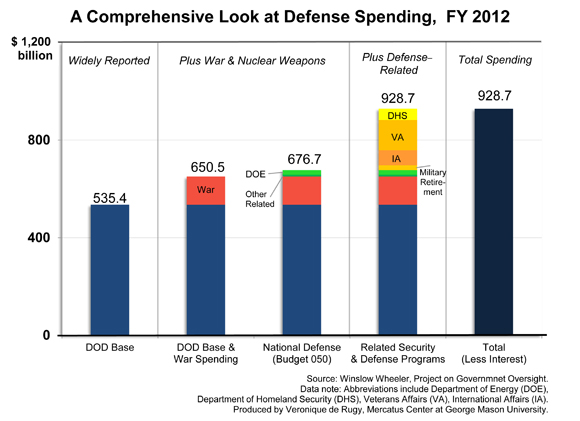
The US government has a firm grip on its number one rank on military budget and spending in the world. While Americans and the global public opinion were told that 535.4 billion US dollars were spent in 2012 on defense , a report by Winslow Wheeler of the Project on Government Oversight suggests that reported defense spending figures underestimate the overall cost of defense and national security programs by a mere 400 billion dollars in FY 2012.

 Probably the most  interesting military-related budgetary  gossip  has been the practice of keeping the operational costs of the wars in Iraq and Afghanistan separate from the main Pentagon budget, as if those costs should not count as much because they are , sort of temporary. There is, admittedly, a sense in which the Iraq War should not be counted as “defense” spending. The war was not an act of defense; it was offense. But that, of course, is not the reason for the practice (begun by the administration that launched the Iraq War) of separating costs of the war from the main defense budget. The reason had much more to do with wanting to understate the actual amount the United States spends on its military. Since high military expenditures are not justified in terms of public opinion within and out of the US. The US in not alone in this race, China, Russia and North Korea and NATO members are in the same category.

 Observers have shown how the true total cost of an endeavor such as the Iraq War goes far beyond what shows up in the federal budget and includes various secondary economic effects.   A big part of the follow-on cost of recent wars is the long-term care of military veterans, especially grievously wounded ones. Such costs are proportionately greater than for previous wars. Due  to modern  body armor and a splendid military medical system, many who would have died in earlier conflicts instead survive—but they are still maimed by the incidents.
War is a very painful and disastrous entity both for humanity but also for nature as well. 
Civil societies should engage in global campaigns to ask governments to stop the arms race and to start more responsible spending for health, education and employment thereby giving all humans the right they deserve to dignified livelihoods. 
Peace is a prerequisite to development and human advancement, the selfish excesses of a minority has led the world to instability and war.
. 

Wednesday, January 16, 2013

Iran, Land of Diversity

The ethnic diversity of Iran is both amazing and unique in many respects. Iranians  come from Persian, Turk, Lor, Kurd, Arab, Baluch, Sistani, Turkemen backgrounds. This ethnic diversity and intercultural interaction has made the Iranian society one of the most dynamic and attractive in terms of national heritage and culture. Local dialects and accents and even ethnic languages are very popular. Local cuisine and traditional dishes are welcomed in every home. Traditional and ethnic art including drama, music, painting and folklore have all evolved to create a very rich cultural backbone. Traditional costumes and colorful clothes are also one of the attractions  specific for each Iranian ethnic group.

Saturday, January 12, 2013

Pew Polls on Iran: Biased or Objective


Pew’s  global attitudes project,  has just released a big batch of new surveys. Among other things, the researchers asked respondents in 21  countries how they feel about Iran.  The results seem to be bad news for Tehran, which seems to be wildly unpopular according to this survey .  According to the information posted on the Pew site, the survey measures popularity of NATO, EU , UN , Russia and China as well.  It is interesting to note that NATO also seems to be quite unfavorable, even in some EU countries like Greece (72%), Spain and the Czech Republic, while polls for Islamic countries other than Turkey are notably  not displayed.  Serious questions on the objective nature and integrity  of such polls surface, considering the biased approach and selection of subjects.
World opinion is largely shaped by global media and news agencies that are funded and heavily influenced by a certain pro-Zionist lobby in the US and worldwide. They have repeatedly relied on this weapon to shape public opinion before the war against Afghanistan, the attack on Iraq,  and Libya.  Western media have done a great service to Israel by  smearing the image of Iran and depicting a totally negative picture for the public to both fear and hate. In reality, the Iranian government which has serious flaws and faces many challenges, particularly after the 2009 disputed elections, is under heavy internal criticism ; but everything is not so dark as western media portray. Iran had the highest scientific growth rate in 2010 due to the booming achievements in academic fields and research. Iranian cities have now developed into modern and attractive metropolitan areas although air pollution is a major impediment. Councils elected by the people are now managing the affairs of cities and villages and despite restrictions the civil society is struggling to improve social indicators.Women have advanced in many areas while they still face some setbacks. When a negative and fearsome image of Iran is systematically  promoted in the  mainstream  global media,  then one would expect such poll results to be natural.
 NATO and US policies in the Middle East and many other parts of the globe in recent decades have resulted in war, bloodshed, terrorism and the general decline of the quality of life for people. The deteriorating conditions of living in  most of Afghanistan and Iraq as well as Libya has occurred as a direct consequence of US adventurism  and occupation which may have led to the downfall of a dictator but has also devastated the economy, undermined basic  infrastructure and left the people in despair.  It is now a general realization that American and NATO forces only pursue their interests in such adventures. Compared to most countries in this region, Iran is well better off. This does not mean that the government meets the expectations of the people. By no means, Iranians look forward to major reforms and changes in their administrative and political system.  However, it is a well known fact now that foreign  intervention does not serve the interests of   nations in the long term and cannot help to promote peace security and democracy among nations and  in the world. People throughout the world are now increasingly awakening to the painful truths of our age.

Friday, December 21, 2012

An Open Letter to President Obama


Dec 19 -2012
Dear President Obama,
Re: Would you also shed a tear for Iranian children with cancer?
Applauding your humane reaction to the recent school shooting in Newtown, Connecticut, we wonder if you would also shed a tear for the plight of Iranian people caught between the devil and the deep blue sea, as a result of the sanctions imposed on them by the international community led by the American government.
In particular, heart-wrenching reports of ordinary Iranians dying due to a widespread shortage of pharmaceutical drugs call for immediate cessation of hostilities toward the Iranian people, caused by the sanctions. Eyewitness reports in the black market for the drugs and the tearful eyes of families of cancer patients scrambling desperately in this market should concern you as much as the Newtown incident did. Although the former happened beyond your control, the pain and suffering of Iran’s cancer patients are a direct consequence of your government’s policies. Whereas there is barely any evidence suggesting sanctions achieve their political goals, they are causing death and devastation to the Iranian cancer patients as you are reading this letter.
A recent report, for example, from a charitable hospital for cancer patients in Tehran, Mahak (http://www.mahak-charity.org/main/fa), indicate a shortage of the following pharmaceutical items:
Amp.BC NU Amp.Melphalan Tab.Mitotane Cap.Procarbazine Amp.Topotecan 4mg-1mg Tab.Lanvis-6Thioguanine
We believe you are a man of conscience, and under your leadership the world has a unique opportunity to leave politics behind and attend to the humanitarian tragedy unfolding in the Iranian populace as a consequence of the sanctions. Will you take this historic opportunity to put people first and ahead of politics? You are well familiar with the following poem by Sa’adi Shirazi:
Human beings are members of a whole, In creation of one essence and soul. If one member is afflicted with pain, Other members uneasy will remain.
If you have no sympathy for human pain, The name of human you cannot retain.
Will you consider living up to it?
The following children died senselessly in the Newtown tragedy:
Charlotte Bacon, Daniel Barden, Olivia Engel, Josephine Gay, Dylan Hockley, Madeleine Hsu, Catherine Hubbard, Chase Kowalski, Jesse Lewis, Ana Marquez-Greene, James Mattioli, Grace McDonnell, Emilie Parker, Jack Pinto, Noah Pozner, Caroline Previdi, Jessica Rekos, Avielle Richman, Benjamin Wheeler, Allison Wyatt.
You have a once-in-a-lifetime chance to demonstrate your true dedication to fundamental human dignity. These children’s souls are watching.
Will you let the suffering of Iranian children with cancer continue or will you choose to put an end to this tragedy by lifting the sanctions on Iranian people?
With hope,
Yours very truly,
Canadian and Iranian Coalition for Peace
CICforpeace@gmail.com
http://cicfp.blogspot.ca/