I published my full speech a day later.
Monday, January 20, 2014
My Speech at Friday Prayers
I was invited to deliver a speech on the occasion of the Clean Air Day at the Friday Prayer ceremony in Tehran. Friday Prayers are an important aspect of religious and political life in Iran, since sermons are devoted to contemporary issues and Friday Leaders provide analysis and insight into national and international developments. In the final hours on Wednesday, they informed me that my speech was not possible . Speculation on why I was first invited and then banned from speaking filled the press
Thursday, January 2, 2014
Tree planting with Christians in Iran
The Ararat Club is a large sports and cultural foundation dating to over 7 decades ago. Armenians who founded the Club in Tehran, manged to allocate an excellent location several years later. Armenians are the major Christian minority residing for centuries in Iran. On the occaision of Christmas and the New Year I was invited last week, to plant a tree and speak at the Club . Hundreds had attended. We planted the tree in the campus and went back to the hall for the ceremony. "We are planting a tree of peace and friendship for the world, as opposed to enmity and hatred, we hope for peace with nature in 2014 as well." I said in my speech. I continued, "For centuries Christians and other minorities have lived in peace and frienship in Iran and I hope those ties of friendship will remain for ever."
Tuesday, December 24, 2013
Greening of Diplomatic Relations between Iran and Italy
Sunday, December 1, 2013
Warsaw and Geneva ,two Venues for Global Peace
Labels:
Environment,
France,
freedom of expression
Friday, November 8, 2013
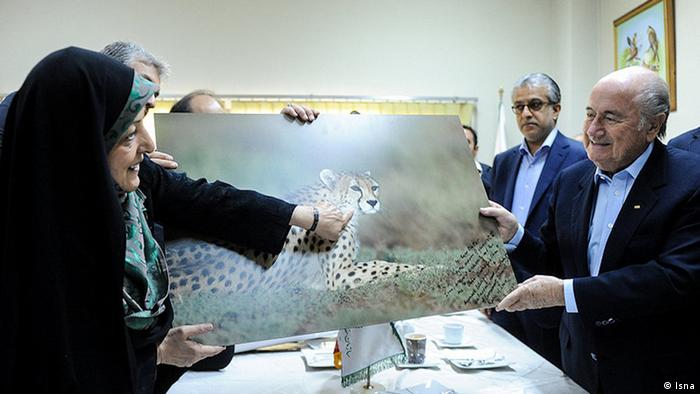
Blatter in Tehran With The Cheetah
Friday, November 1, 2013
A Call for Putin
Dr. Massoumeh Ebtekar called for immediate release of Greenpeace Activists
http://www.tehrantimes.com/politics/111863-irans-environmental-chief-urges-russia-to-release-greenpeace-activists-
No government in any part of the world should use violence and deprivation as tools against civil organizations and environmental activists who care for the future of the earth
(Iran's Environment News Agency) Following the detention of 30 Green Peace activists protesting against Russia's oil drilling in the arctic who were further charged with hooliganism and piracy by a court in Russia, Dr. Massoumeh Ebtekar called for immediate release of these activist.
"Given that this act is directly in relation to non-exploitation of new hydrocarbon resources in the arctic and aimed at stopping the global warming, it is indeed an act of compassion and apprehension," said Dr. Massoumeh Ebtekar, head of Department of Environment of Iran and winner of the « Champion of The Earth » title in 2006, in an interview with Iran's Environmental News Agency.
"I expect that by realizing this fact, the government of Russia would at once order the release of these activists," added Massoumeh Ebtekar.
She noted that: "No government in any part of the world should use violence and deprivation as tools against civil organizations and environmental activists who care for the future of the earth, and as a champion of the earth, I call upon the Russian government to scrutinize every dimension of this case and act to remove the restrictions off these Greenpeace activists.
Friday, October 4, 2013
Peace an Imperative
The Guardian published this op-ed yesterday. I am providing the text as well as links to the newspaper and related news stories here on my blog.
Peace is an Imperative
The past half-century has been an era of unprecedented human advancement. Yet it is equally defined as an epoch of numerous wars and conflicts leading to millions of deaths and endless suffering. Peace has been more elusive than ever in certain parts of the world such as the Middle East and Africa.
In the Islamic heartland we have seen more than 10 major wars and conflicts devastate the region in three decades. While the origin of each conflict rests in both internal and external elements, there are lessons to be learned by global leaders and actions to be taken so that such wars and carnage cease.
Looking forward, these societies, with the support of the international community, need long-term efforts to address their deep wounds, mend their broken fabric, rebuild cities, reinvigorate agricultural areas and revive the shattered natural and human environment.
Because of the human devastation that always follows war, environmental damage is often overlooked, and poorly quantified and evaluated. Yet this destruction is long term, destroys natural resources and inflicts major economic and environmental losses, for generations in some cases. In other instances, a deliberate destruction of natural resources and water is aimed at weakening the so-called enemy. Unconventional warfare has also been employed, causing excessive contamination of soil and water, as in the case of the use of mustard gas by Saddam Hussein against Iranian civilians – still suffering 25 years after the fact.
The deployment of depleted uranium munitions by coalition forces throughout Iraq will impact that nation literally for centuries.
All this underlines the imperative of peace as a prerequisite for the development and growth of all nations. A long history of foreign intervention and occupation, weak governance systems stemming from a lack of transparency and accountability, civil strife and conflicts are all reasons for tensions and war in this region. A complicated history of 19th- and 20th-century western cartographic invention, calculated poverty and frustration has fuelled flames of real hatred. One result is a distorted and violent faction of "takfiris" whose practice today remains in contradiction with the spirit and basic teachings of Islam. Although Islam advocates resistance in the face of aggression and allows the oppressed to defend their collective and individual dignity and human worth, there are also numerous references to compassion, moral standards, ethical values and avoidance of extremism in the Holy Qur'an. I believe that war and extremism are two major threats to sustainable development in today's world.
Considering these circumstances, any effort to strengthen ties among nations, to resolve conflicts and to prevent further tensions is an effort to advance humanity. The west's political stalemate with Iran over its nuclear energy programme and the crisis and humanitarian calamity in Syria are two contemporary challenges that require urgent resolution. The use of force and the threat to use force are both contrary to the spirit of the UN charter.
The 68th general assembly of the United Nations provided a unique opportunity for the leaders of Iran and the west to engage in constructive dialogue to resolve outstanding issues pertaining to long years of non-communication stemming from an even longer history of US intervention in Iran. These leaders came with a mandate to negotiate and demonstrated their desire to do so with the first presidential telephone conversation between the two sides since 1979. That might appear insignificant, but was of huge global political importance. The foreign ministers had previously sat together face to face and positively changed the atmosphere for dialogue and resolution of conflict in the region. This development on both sides succeeded despite strong pressure from hardliners and those looking backwards instead of forwards within the political context of their respective nations.
President Rouhani, who called for change and moderation in Iran, was elected by a competitive democratic voting process in Iran. He now has the overwhelming mandate of the general populace, including the educated elite and critics who were estranged for eight years by the irrational and counterproductive policies of the former president. The new president came to the UN with an unrestricted mandate to settle the nuclear dispute with the west. President Rouhani proposed a global movement he called Wave – World Against Violence and Extremism – in his UN address. He fared well after the strong diplomatic overtures and arguments that the foreign minister, Javad Zarif, put forward on Iran's behalf.
When the supreme leader called these efforts "heroic flexibility", it became clear that there is a concerted effort for the resolution of domestic disputes too. President Rouhani's election has created optimism for an internal resolution of political tensions. There has been a gradual release of political prisoners who were detained on the grounds of opposition to the results of the controversial elections of 2009. This demonstrates a unified and genuine effort on behalf of Iran to change the political atmosphere while adhering to the basic precepts and principles of the Islamic republic and the inalienable right of Iran to enrich uranium for peaceful purposes.
President Obama also indicated that the US does not seek regime change in Tehran and that the two countries can have a different, more open relationship after the dispute is settled. While the US seems ready to reciprocate, many observers question whether all the elements of the US administration are pulling in the same direction and whether there will be practical confidence-building measures in the near future to consolidate the fruits of this visit.
In 1998 when President Khatami came to the UN with the novel approach of "Dialogue among civilisations", he faced an unrelenting storm of internal pressure while the US president branded Iran a member of the "axis of evil", thus neutralising his excellent initiative at both the domestic and global levels. With the passage of 15 years and the loss of millions of lives in global wars, perhaps we have all learned our lesson, and global leaders are more prepared to say no to militarism, terrorism, nuclear arsenals and extremism.
As an environmentalist and a political activist who was involved very early on in my life in the tumultuous events of Iran's revolution, I sincerely believe that we need a global alliance today against war and violence. We need to stand up for peace. We need to sign up for protecting our precious natural environment. The past really needs to become the past. Wide open vistas are waiting for humanity to simply open its collective eyes.
Tuesday, September 24, 2013
Our Time to Engage
Saturday, September 14, 2013
To Serve for the Environment
Sometimes destiny plays its game, sometimes you feel there is a reason behind God's will, a reason that you do not know or understand. The Iranian society faced very difficult times during the ninth and tenth governments. Radical and unexperienced groups infiltrated the executive branches and dealt severe blows to the economy, environment and culture. Students, journalists and activists faced harsh repercussions for resisting the deviations of those in power. We experienced set backs in many areas including international relations. Very few believed that a transformation could occur to change these trends, but Presidential elections posed an opportunity which the people took for granted and changed the negative course of events. The composition of the new cabinet and the new Foreign Minister Dr. Zarif are all signs of a new era for Iran in both domestic and international affairs.
I was appointed as Vice President and Head of the Department of Environment by Dr. Rouhani on Tuesday. The difficult and deteriorating conditions of Iran's environment is manifest and this underlines the challenges that I will face. I believe that God has vowed to support His servants, if they stay steadfast in the path of righteousness and make effort to serve his creation . I hope and pray that I would be able to accomplish what I have undertaken, I pray that God assist me to withstand the pressures and difficulties to tolerate and listen to the expectations of the people and civil society.
I hope that we can create synergisms and partnerships between industries, private sectors and all those in the economic arena to save Iran's precious biodiversity and nature. As a UNEP Champion of the Earth , I look forward to collaboration with academics and scientists from across the globe. Environmental issues are global in nature and I call upon all international organisations, international NGO' s and environmentalists to join our campaign to save our precious natural heritage. I believe that environmental diplomacy can help to foster peace and better relations among nations in today's world.
I began work a few hours after appointment , at 8 am in the DOE to indicate my resolve to work hard to change things. On my second day, I visited Lake Urumia National Park which is now under serious water stress and parts have dried up. Urumia is the largest lake in Iran. The DOE has completed many research projects in partnership with international consultants, but now is the time to act.
Wednesday, September 4, 2013
Reformist Council Leader in Charge
I have served as councillor for Tehran City Council for 6 years 4 months and 2 days. The third round of Councils in Iran was exceptional in many respects. First, was the duration of this term which was extended after the disputed presidential elections of 2009. After that year, the reformists faced excessive pressures and as the few remaining active elements in the power construct, we had to make all efforts to reverse the negative trends and to speak out on behalf of the people. The diverse political factions in the council and the meaningful collaboration among them despite pressures against reformists, was also unique in many respects.
In addition, along with a capable and experienced team of experts, we established and conducted up to 1000 sessions, meetings ,working groups and visits in the Environment Committee. We endeavoured to promote a model of sustainable and democratic governance in the city . We enacted more than 40 bills for the council on environmental issues and amended more than 50 others to reflect environmental concerns. The committee also visited the 22 districts and environment related activities in Tehran each at least 3 times.
We conducted the large meetings on the basis of a dynamic model of intersectoral and integrated urban management. Municipal authorities, government officials, NGOs ,professionals as well as private sector representatives were invited in each field of expertise to debate the terms of a new bill ,to seek intersectoral approaches or to oversee and regulate the functions of the executive agents. Once a year we also invited council members from across the country to exchange views and experiences and so they could also follow our model in their respective cities.

In the open sessions of the City Council, I was one of those who criticised and spoke up against the shortcomings of the government and municipal authorities. Even though I was disqualified to run for the next round , I joined the reformist election campaigns for reformist council candidates as well as support for President Rouhani. Following the open invitation of former President Khatami and president Rafsanjani, people came to the polls and elected reformists candidates. In Tehran,we now have at least 16 reformists out of 31. Yesterday, in the first day of the new council members elected Ahmad Masjed Jamei as the new Head . Masjed Jamei was Minister of Culture during President Khatami . I have written about him and made several interviews about him in todays newspapers and sites. This is a great transformation.
Saturday, August 31, 2013
No To War on Syria
I was just watching France 24 broadcasting a report on the massive internet campaign in Facebook, Twitter and other social networks against an attack on Syria. Many have compared the logic to go to war on the pretext of deployment of chemical weapons by the Syrian government, with the reasons provided by George W. Bush in his aggression against Iraq a decade ago. The terrible massacre of civilians by the use of Sarin is another tragedy for the suffering Syrian people.
This wave of awakening and protest is also seen on the streets in certain American and European cities as well, where demonstrations have taken place against the war today. Reports indicate that this trend will continue throughout the week.
The British House of Commons has been the game changer in this trend. Their vote not to sanction war against Syria has left the US in a difficult predicament.Considering the difficult task given to the UN Inspector group in identifying the source of the Sarin nerve gas employed against the people of Damascus, we have to hope that they do not report under pressure or biased information. Their job is both difficult and very precise. We have to pray that this group led by a neruo-physiologist, places their conscience before any other consideration. Rebel groups had reported more than a month ago, that they had confiscated a military chemical weapons storage in Syria.Therefore, it is also possible that they have used weapons which are very similar to those of the government against the people.
I hope that influential political figures on both sides would relinquish hostilities and violence and begin an intensive process of national reconciliation.
These are very sensitive times.
Tuesday, August 20, 2013
CIA confirms role in 1953 coup d'etat in Iran
Now that the evidence published by the National Security Archives provides new details on the 1953 Coup d'etat which led to the overthrow of Dr. Mohammad Mosaddeq ( the nationalist Prime minster of Iran who nationalized oil), the Iranian Parlaiment has taken action. They have adopted a bill to evaluate and take international legal action against the US and British governments for their interference in internal affairs of Iran.
This evidence includes declassified CIA documents on the United States' role in the controversial AJAX operation. American and British involvement in Dr. Mosaddeq's ouster has long been public knowledge, but this evidence includes what is believed to be the CIA's first formal acknowledgement that the agency helped to plan and execute the coup.The 1953 coup remains an issue of global interest because US Iran relations are still very bitter and this tension has overshadowed international equations in the past decades. This event paved way for 25 years of tyranny and cruel dictatorial rule in Iran. Students who led the takeover of the American embassy in Tehran in 1979 mentioned the 1953 CIA led Coup as one of the preoccupations that led them to take this drastic action to prevent a "repetition of history".
The issue is more political than academic. Politicians and observers on all sides, regularly invoke the coup to show that super powers are primarily responsible for the country's historical trajectory. This regularly brings up the question whether the United States can be trusted to respect Iran's sovereignty, or whether the US needs to apologize for its prior interference before relations can improve.
While the three histories presented and the narrations are very important in terms of Iranian history and much needs to be done to dissect and analyze the information, it still remains to be known in practice how much of the share of the plot and the ensuing tragedy is to be attributed to Iranian forces and how much attributed to foreign interference.
21 CIA documents have now been posted (in addition to 14 previously unpublished British documents), which reinforce the conclusion that the United States, (the CIA in particular) and the British government, devoted extensive resources and high-level policy attention toward bringing about Mosaddeq's overthrow, and bringing a cruel dictator back to power for 25 years.
These documents also show that both governments were for a long time, concerned that the disclosure of these realities would tarnish their prestige as leaders of the free world and supporters of democracy and as governments that championed human rights in the world.
Now that the US is preparing its 48th or so intervention in a sovereign country under vague pretexts, it becomes incumbent upon American citizens to awaken up to the painful realities of their government's imperialistic foreign policy. Syria is now a new test ground , a test ground for new modern American artillery on the one hand and a test ground for the living consciences of global citizens witnessing a new military aggression in the Middle East on the other.
Subscribe to:
Posts (Atom)