Tuesday, December 24, 2013

Greening of Diplomatic Relations between Iran and Italy


I met with Emma Bonino, the Italian Foreign Minister in Tehran on Saturday.She came to the DOE only minutes affter arriving at Mehrabad Airport . Nineteen journalists and members of the press accompanied her in this important visit to Iran. The first part of our talks focused on bilateral relations and changes that are anticipated to occur after the election of Dr.Rouhani and the new round of 5+1 talks on the nuclear issue. Ms. Bonino stressed upon her government's resolve to enhance relations with Iran despite the pressures from radicals and "nervous people" as she put it. We also spoke about how important this trend is for global peace and security. The adoption of the WAVE Resoution in the UNGA is a significant milestone after the Dialogue Among Civilization Resolution of 2001, I noted. Then, I mentioned the important policies we pursue in Iran to improve the quality of life and how sanctions have impeded that trend and now how bilateral relations could enable Iran to move ahead in this area. Wetland management including Lake Urumieh, Hamoon International Wetland and others, the Dust/Haze phenomena and green technologies were all discussed in the meeting. We decided to finalize an MOU on these matters as soon as possible. I told her the first phase of your visit consisted of the greening of bilateral relations between Iran and Italy, which I hope will benefit both nations as well as the global environment. 
We then took her to visit our Biodiversity Museum in the Pardisan Park . A brief news conference concluded the 1/30 hour visit.  I also gave her my book "Natural Peace", which is a compilation of speeches I had in my first term as Vice President.

Sunday, December 1, 2013

Warsaw and Geneva ,two Venues for Global Peace


I attended the COP19 conference on climate change in Warsaw last week. The global community has sensed an urgency in the matter, but little action has been taken to reverse the devastating trend of the warming of the earth's atmosphere and the ensuing extreme weather events , drought, rising sea levels and immense social and economic losses incurred upon societies. In Warsaw, global powers that are responsible for the major part of the green house gases produced during the industrial era were not ready to accept their historical responsibilities and developing countries, many who are still grappling with abject poverty in their societies, were not ready to undergo quotas to reduce their GGHs drastically, when the major part of the industrialized world including the US never acceeded to the Kyoto protocol. The EU initially pushed to impose their version on the rest of the world but they faced a strong group of like minded developing countries who threatened to leave the conference if consensus was not achieved based on common understanding. In the end, a neogiated text was agreed upon in the final moments, to save the negotiation process. During my stay in Warsaw, I was invited to speak about the role of women in promoting global peace at the European Academy of Diplomacy, I also delivered my country speech at the opening of the high level session on the first day. A press conference with Polish journalists, a speech at PISM a Polish peace research institute on the Internal and External Evolution of https://mail.google.com/mail/u/0/s/?view=att&th=1429fa1502b42547&attid=0.1&disp=attd&safe=1&zw and a long working dinner with the Polish foreign minister were also on my agenda. Since the sensitive 5+1 negotiations with Iran were underway then in Geneva, they overshadowed our talks in Warsaw. I had the chnace to speak with the President of Poland at his reception and along with the Iranian delegation we had a lengthly meeting Mr.Ban Ki Moon, the UNSG. In that meeting, I told him I tweeted last night : Planet earth pleads us tonight: Give the world a chance for peace in Geneva , give the global environment a chance in Warsaw. He liked the tweet but sarcastically also noted that it was similar to what he had said a few weeks ago : Give diplomacy a chance in Syria! The success of the 5+1 and Iran negotiations in Geneva was a great achievement for peace and multilateralism, as opposed to the violence and conflict prone policies in today's world. This success proves that even the most difficult and apparently insurmountable obstacles can be overcome with patience and dialogue.https://mail-attachment.googleusercontent.com/attachment/u/0/s/?view=att&th=1429fa1502b42547&attid=0.1&disp=attd&safe=1&zw&saduie=AG9B_P-en6RqDALqBdRUe3mK1csg&sadet=1385872288279&sads=TvPHgoxBnrX1FI_wImmXINOyNOQ

Friday, November 8, 2013

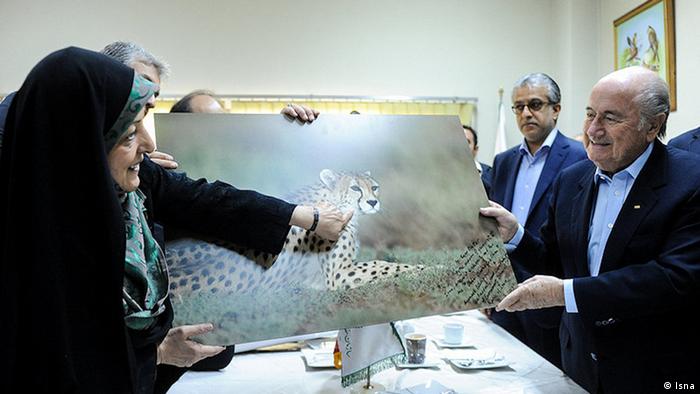
Blatter in Tehran With The Cheetah


Sepp Blatter, the head of FIFA visited the Biodiversity Museum at Pardisan Park on Thursday as part of his visit to Iran last week. Football fans in Iran were overwhelmed to hear that Blatter supported Iran's environmental initiative to use the Asiatic Cheetah which is an endangered species in Iran, as the emblem of Iran's team at the 2014 World Cup in Brazil. The Cheetah is now extinct in all of Asia except Iran .Based on a conservation project starting during my first term in 2001, NGOs, specialists and international organisations began a conservation project. The project was evaluated as successful in preventing the extinction of the Cheetah in its first phase. I signed the second phase of the project with UNDP last week. We spoke about the need to promote environmental awareness for football fans world wide and when Blatter named the visit a Cheetah Coalition I noted that we could also propose an international mechanism for this important purpose. Blatter welcomed the proposal which I will follow.

Friday, November 1, 2013

A Call for Putin

Dr. Massoumeh Ebtekar called for immediate release of Greenpeace Activists http://www.tehrantimes.com/politics/111863-irans-environmental-chief-urges-russia-to-release-greenpeace-activists- No government in any part of the world should use violence and deprivation as tools against civil organizations and environmental activists who care for the future of the earth (Iran's Environment News Agency) Following the detention of 30 Green Peace activists protesting against Russia's oil drilling in the arctic who were further charged with hooliganism and piracy by a court in Russia, Dr. Massoumeh Ebtekar called for immediate release of these activist. "Given that this act is directly in relation to non-exploitation of new hydrocarbon resources in the arctic and aimed at stopping the global warming, it is indeed an act of compassion and apprehension," said Dr. Massoumeh Ebtekar, head of Department of Environment of Iran and winner of the « Champion of The Earth » title in 2006, in an interview with Iran's Environmental News Agency. "I expect that by realizing this fact, the government of Russia would at once order the release of these activists," added Massoumeh Ebtekar. She noted that: "No government in any part of the world should use violence and deprivation as tools against civil organizations and environmental activists who care for the future of the earth, and as a champion of the earth, I call upon the Russian government to scrutinize every dimension of this case and act to remove the restrictions off these Greenpeace activists.

Friday, October 4, 2013

Peace an Imperative

The Guardian published this op-ed yesterday. I am providing the text as well as links to the newspaper and related news stories here on my blog. Peace is an Imperative
The past half-century has been an era of unprecedented human advancement. Yet it is equally defined as an epoch of numerous wars and conflicts leading to millions of deaths and endless suffering. Peace has been more elusive than ever in certain parts of the world such as the Middle East and Africa. In the Islamic heartland we have seen more than 10 major wars and conflicts devastate the region in three decades. While the origin of each conflict rests in both internal and external elements, there are lessons to be learned by global leaders and actions to be taken so that such wars and carnage cease. Looking forward, these societies, with the support of the international community, need long-term efforts to address their deep wounds, mend their broken fabric, rebuild cities, reinvigorate agricultural areas and revive the shattered natural and human environment. Because of the human devastation that always follows war, environmental damage is often overlooked, and poorly quantified and evaluated. Yet this destruction is long term, destroys natural resources and inflicts major economic and environmental losses, for generations in some cases. In other instances, a deliberate destruction of natural resources and water is aimed at weakening the so-called enemy. Unconventional warfare has also been employed, causing excessive contamination of soil and water, as in the case of the use of mustard gas by Saddam Hussein against Iranian civilians – still suffering 25 years after the fact. The deployment of depleted uranium munitions by coalition forces throughout Iraq will impact that nation literally for centuries. All this underlines the imperative of peace as a prerequisite for the development and growth of all nations. A long history of foreign intervention and occupation, weak governance systems stemming from a lack of transparency and accountability, civil strife and conflicts are all reasons for tensions and war in this region. A complicated history of 19th- and 20th-century western cartographic invention, calculated poverty and frustration has fuelled flames of real hatred. One result is a distorted and violent faction of "takfiris" whose practice today remains in contradiction with the spirit and basic teachings of Islam. Although Islam advocates resistance in the face of aggression and allows the oppressed to defend their collective and individual dignity and human worth, there are also numerous references to compassion, moral standards, ethical values and avoidance of extremism in the Holy Qur'an. I believe that war and extremism are two major threats to sustainable development in today's world. Considering these circumstances, any effort to strengthen ties among nations, to resolve conflicts and to prevent further tensions is an effort to advance humanity. The west's political stalemate with Iran over its nuclear energy programme and the crisis and humanitarian calamity in Syria are two contemporary challenges that require urgent resolution. The use of force and the threat to use force are both contrary to the spirit of the UN charter. The 68th general assembly of the United Nations provided a unique opportunity for the leaders of Iran and the west to engage in constructive dialogue to resolve outstanding issues pertaining to long years of non-communication stemming from an even longer history of US intervention in Iran. These leaders came with a mandate to negotiate and demonstrated their desire to do so with the first presidential telephone conversation between the two sides since 1979. That might appear insignificant, but was of huge global political importance. The foreign ministers had previously sat together face to face and positively changed the atmosphere for dialogue and resolution of conflict in the region. This development on both sides succeeded despite strong pressure from hardliners and those looking backwards instead of forwards within the political context of their respective nations. President Rouhani, who called for change and moderation in Iran, was elected by a competitive democratic voting process in Iran. He now has the overwhelming mandate of the general populace, including the educated elite and critics who were estranged for eight years by the irrational and counterproductive policies of the former president. The new president came to the UN with an unrestricted mandate to settle the nuclear dispute with the west. President Rouhani proposed a global movement he called Wave – World Against Violence and Extremism – in his UN address. He fared well after the strong diplomatic overtures and arguments that the foreign minister, Javad Zarif, put forward on Iran's behalf. When the supreme leader called these efforts "heroic flexibility", it became clear that there is a concerted effort for the resolution of domestic disputes too. President Rouhani's election has created optimism for an internal resolution of political tensions. There has been a gradual release of political prisoners who were detained on the grounds of opposition to the results of the controversial elections of 2009. This demonstrates a unified and genuine effort on behalf of Iran to change the political atmosphere while adhering to the basic precepts and principles of the Islamic republic and the inalienable right of Iran to enrich uranium for peaceful purposes. President Obama also indicated that the US does not seek regime change in Tehran and that the two countries can have a different, more open relationship after the dispute is settled. While the US seems ready to reciprocate, many observers question whether all the elements of the US administration are pulling in the same direction and whether there will be practical confidence-building measures in the near future to consolidate the fruits of this visit. In 1998 when President Khatami came to the UN with the novel approach of "Dialogue among civilisations", he faced an unrelenting storm of internal pressure while the US president branded Iran a member of the "axis of evil", thus neutralising his excellent initiative at both the domestic and global levels. With the passage of 15 years and the loss of millions of lives in global wars, perhaps we have all learned our lesson, and global leaders are more prepared to say no to militarism, terrorism, nuclear arsenals and extremism. As an environmentalist and a political activist who was involved very early on in my life in the tumultuous events of Iran's revolution, I sincerely believe that we need a global alliance today against war and violence. We need to stand up for peace. We need to sign up for protecting our precious natural environment. The past really needs to become the past. Wide open vistas are waiting for humanity to simply open its collective eyes.

Tuesday, September 24, 2013

Our Time to Engage


On Sunday, In a ceremony to mark the 26th anniversary of the Montreal protocol, the resident UN Coordinator Garry Lewis read a meassage from Achim Steiner, the executive director of UNEP, congratulating my appointment as vice president of Iran. Steiner had also pointed to the UNEP Champion of the Earth award in his letter. I spoke in that ceremony and mentioned the resolve of the government of Dr. Rohani to improve relations with the world and our policy of environmental diplomacy in the DOE as a strategy to enhance our role in the international community and promote regional and international collboration to face the current environmental challenges. I also planted a tree on that day in the name of peace,on the international day of peace and dialogue among civilisations. We also named a street in Pardisan Park on that occasion. A number of prominent political prisoners were freed last week includind dr. Aminzadeh the former deputy minister and Nasrin Sotudeh. Hopes are high for the release of the remaining political prisoners who were detained after or due to the disputed elections of 2009. President Rouhani has written an important note entitled Time to Engage in the Washington Post and former President Khatami has authored an article for the Guardian. In addition, President Rouhani is in New York for the UNGA session and there is much speculation that direct negotiations between the US and Iran will ease tensions in the region and help to resolve the current nuclear standoff. I hope President Obama understands the unique opportunity created by the democratic elections leading to a wave of change in Iran. Iran is looking forward to a new era of constructive dialogue and engagement with the world. http://www.theguardian.com/commentisfree/2013/sep/23/iran-west-not-turn-back-diplomacy

Saturday, September 14, 2013

To Serve for the Environment

Sometimes destiny plays its game, sometimes you feel there is a reason behind God's will, a reason that you do not know or understand. The Iranian society faced very difficult times during the ninth and tenth governments. Radical and unexperienced groups infiltrated the executive branches and dealt severe blows to the economy, environment and culture. Students, journalists and activists faced harsh repercussions for resisting the deviations of those in power. We experienced set backs in many areas including international relations. Very few believed that a transformation could occur to change these trends, but  Presidential elections posed an opportunity which the people took for granted and changed the negative course of events. The composition of the new cabinet and the new Foreign Minister Dr. Zarif are all signs of a new era for Iran in both domestic and international affairs.

I was appointed as Vice President and Head of the Department of Environment by Dr. Rouhani on Tuesday. The difficult and deteriorating conditions of Iran's environment is manifest and this underlines the challenges that I will face. I believe that God has vowed to support His servants, if they stay steadfast in the path of righteousness and make effort to serve his creation . I hope and pray that I would be able to accomplish what I have undertaken, I pray that God assist me to withstand the pressures and difficulties to tolerate and listen to the expectations of the people and civil society.
 I hope that we can create synergisms and partnerships between industries, private sectors and all those in the economic arena to save Iran's precious biodiversity and nature. As a UNEP Champion of the Earth , I look forward to collaboration with academics and scientists from across the globe. Environmental issues are global in nature and I call upon all international organisations, international NGO' s and environmentalists to join our campaign to save our precious natural heritage.  I believe that environmental diplomacy can help to foster peace and better relations among nations in today's world. 
I began work a few hours after appointment , at 8 am in the DOE to indicate my resolve to work hard to change things. On my second day, I visited Lake Urumia National Park which is now under serious water stress and parts have dried up. Urumia is the largest lake in Iran. The DOE has completed many research projects in partnership with international consultants, but now is the time to act.